Rebugging the Planet: The Remarkable Things that Insects (and Other Invertebrates) Do - And Why We Need to Love Them More by Vicki Hird
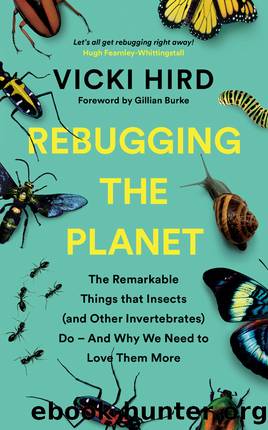
Author:Vicki Hird
Language: eng
Format: epub
Publisher: Chelsea Green Publishing
Published: 2021-08-29T16:00:00+00:00
But it is not always possible to stop invasions. The colourful harlequin ladybird or ladybug, which comes in several colours, eats our native ladybird species as well as their prey. We know how useful our native ladybirds are for controlling aphids and other pests, so an invasive insect that eats their babies is unwelcome. But controlling them is tricky as they have settled in everywhere - they are now too numerous to destroy individually and any chemicals would harm our native beetles. We may have to just let a new balance of beetles take shape.
Ultimately, we need greater controls on the trade in goods that can bring in invasive species. And we need strong public campaigns so that everyone is aware of the dangers. Support for more domestic plant nurseries would also help so they can safely provide the plants people need - ideally native species grown without chemicals.
An artificial environment: light and noise pollution and wi-fi/5G
I was intrigued and alarmed to find out that some of the ways we run our lives now creates new dangers for the bugs. We need a far better understanding of these potential problems, particularly as they are all growing in intensity.
Too much light? The increase in the distribution and intensity of artificial light can disrupt natural invertebrate behaviours and life cycles.17 Moths, which are crucial pollinators, are attracted to artificial lights at night, and aquatic insects can be attracted away from water by light shining on surfaces. When bugs are exposed to unnatural light patterns, such as all-night street lights, it can disrupt the natural light-dark rhythms they use for regulating activities and for movement. This can disrupt their feeding, breeding and movement, leading to lower breeding numbers and more isolated populations as they are not mingling as they would normally. International studies have confirmed the negative impact of artificial light on invertebrate species, from snails to aphids, and confirm the need for action - for instance, to specify municipal lighting design that involves better timers and minimises glare and illumination, such as narrow-spectrum LED lighting, which is less attractive to most insects.
Too much noise? One study on noise pollution found that the hermit crab selection of which shell to inhabit was significantly affected by noise.18 When exposed to noise, the crabs approached the shell faster, spent less time investigating it, and entered it sooner. We can imagine how this may well affect the crabâs survival if it ends up choosing a low-quality home. Noise is a surprisingly serious environmental pollutant, now recognised as a major global problem. Bugs can detect noise but they also use noise to communicate and it is only recently that scientists have begun to see how we are harming invertebrates by the noise we make. A 2019 review of over 100 studies on noise pollution impact (including on arthropods and molluscs) noted that most species responded to noise, and that we may be underestimating its impact.19 It can affect development, bodily functions, and behaviour. Crickets, bush crickets and grasshoppers are extremely sensitive to sound as they use it to communicate over large distances.
Download
This site does not store any files on its server. We only index and link to content provided by other sites. Please contact the content providers to delete copyright contents if any and email us, we'll remove relevant links or contents immediately.
Sapiens: A Brief History of Humankind by Yuval Noah Harari(14389)
The Tidewater Tales by John Barth(12659)
Mastermind: How to Think Like Sherlock Holmes by Maria Konnikova(7347)
The Thirst by Nesbo Jo(6944)
Do No Harm Stories of Life, Death and Brain Surgery by Henry Marsh(6941)
Why We Sleep: Unlocking the Power of Sleep and Dreams by Matthew Walker(6725)
Life 3.0: Being Human in the Age of Artificial Intelligence by Tegmark Max(5558)
Sapiens by Yuval Noah Harari(5372)
The Body: A Guide for Occupants by Bill Bryson(5097)
The Longevity Diet by Valter Longo(5064)
The Rules Do Not Apply by Ariel Levy(4969)
The Immortal Life of Henrietta Lacks by Rebecca Skloot(4588)
Animal Frequency by Melissa Alvarez(4474)
Why We Sleep by Matthew Walker(4447)
The Hacking of the American Mind by Robert H. Lustig(4383)
Yoga Anatomy by Kaminoff Leslie(4363)
All Creatures Great and Small by James Herriot(4322)
Double Down (Diary of a Wimpy Kid Book 11) by Jeff Kinney(4272)
Embedded Programming with Modern C++ Cookbook by Igor Viarheichyk(4182)
